Crash-Test It Before You Build It: How Digital Twins Save Companies Millions
In January 2026, PepsiCo announced that it had started building exact virtual copies of some of its U.S. factories and warehouses, right down to the machines, conveyor belts and the paths workers walk. Before moving a single piece of real equipment, PepsiCo tested its changes on the virtual copies first.
The results were hard to ignore. The company spotted up to 90% of potential design problems before anything was built. One production line pumped out 20% more product. And PepsiCo expects to spend up to 15% less on new equipment and buildings, because the virtual models showed it where extra capacity was already hiding.
That virtual copy has a name: a digital twin. And building and using them is one of the most valuable skills a supply chain professional can have right now.
What is a digital twin?
A digital twin is a computer model that behaves like a real factory, warehouse, hospital or entire supply chain. It isn’t just a 3D picture. It is powered by simulation, which means the computer plays out what happens over days, weeks or months: orders arriving, trucks getting stuck in traffic, machines breaking down, workers going on break, and customers waiting.
Think of it like a flight simulator. Airlines don’t let new pilots learn to handle an engine failure on a real plane full of passengers. They practice in a simulator, where mistakes are free. A digital twin gives a business the same thing: a safe place to try ideas, make mistakes and learn from them before real money, real products and real customers are on the line.
Companies use digital twins for four big jobs.
1. Getting the most out of every dollar
Every business wants to keep customers happy by getting them what they want, when they want it. The catch is doing that at the lowest possible cost. More warehouses, more trucks and more inventory make it easy to deliver fast, but they also cost a fortune.
Simulation optimization helps a company find the sweet spot. The computer runs the digital twin hundreds or thousands of times, each time with a slightly different setup: a different number of workers, a different amount of stock on the shelves, a different warehouse location. Then it reports which setup meets customer expectations for the least money. It’s a bit like a coach testing every possible lineup in practice to find the one that wins the most games.
2. Measuring risk with real numbers
A supply chain can be disrupted by all kinds of things: a storm closes a port, a key supplier falls behind, a machine breaks, or demand suddenly doubles because a product goes viral.
Managers used to say things like “there’s some chance we’ll run out of stock this winter.” A digital twin lets them say something much more useful: “In 1,000 simulated winters, we ran out of stock 87 times, and each shortage cost us about $40,000 in lost sales.” Once you can put a number on a risk, you can decide whether it’s worth paying to prevent it.
3. Practicing for the unexpected
Knowing a risk exists is only half the job. You also need a plan for when it happens. With a digital twin, a company can run “fire drills” for its supply chain. What if our biggest supplier shuts down for a month? What if a hurricane closes our main distribution center? What if shipping costs double?
Managers can try out different backup plans, like adding a second supplier, keeping extra safety stock or rerouting trucks, and see which one actually works before the crisis hits, not in a panic while it’s happening.
4. Comparing options side by side
Should we build a new warehouse in Ohio or in Texas? Should we buy a faster machine or hire a second shift? Should we ship by truck or by train?
These decisions can cost millions of dollars and are hard to undo. A digital twin lets managers test each option under the same conditions and compare the results: cost, delivery speed, how much inventory is needed, and how well each one holds up when things go wrong. Instead of arguing over opinions, the team can look at the evidence.
The UM-Flint advantage: Learning professional supply chain software as part of your coursework




Here’s the exciting part. In the BS in Supply Chain Management and MS in Supply Chain Management programs at the University of Michigan-Flint, students don’t just read about digital twins. They build them, using the same professional software that major companies use every day.
Simio
Simio is simulation software for building digital twins of factories, warehouses, hospitals, airports and supply chains. You build a model by dragging and dropping objects like machines, workers and vehicles, then watch it run in 3D. Companies in manufacturing, aerospace, healthcare, logistics and food production use it to test “what if” questions without the risk of trying them in real life, and to avoid expensive mistakes. At aluminum maker Alcoa, a Simio digital twin runs around the clock to help plan production.
AnyLogic
AnyLogic is one of the most flexible simulation tools in the world. Most simulation software models a system in just one way. AnyLogic lets you mix three different styles in the same model: following each item as it moves through a process, giving individual people or trucks their own behavior, and tracking big-picture trends over time. That makes it great for messy, real-world problems where spreadsheets just can’t keep up. For example, the consulting firm Accenture used AnyLogic to build a digital twin of the whole supply chain for a U.S. exercise equipment brand. The model made the company’s delivery time predictions 57% more accurate and cut the logistics costs of deciding where to store inventory by 20%.
anyLogistix
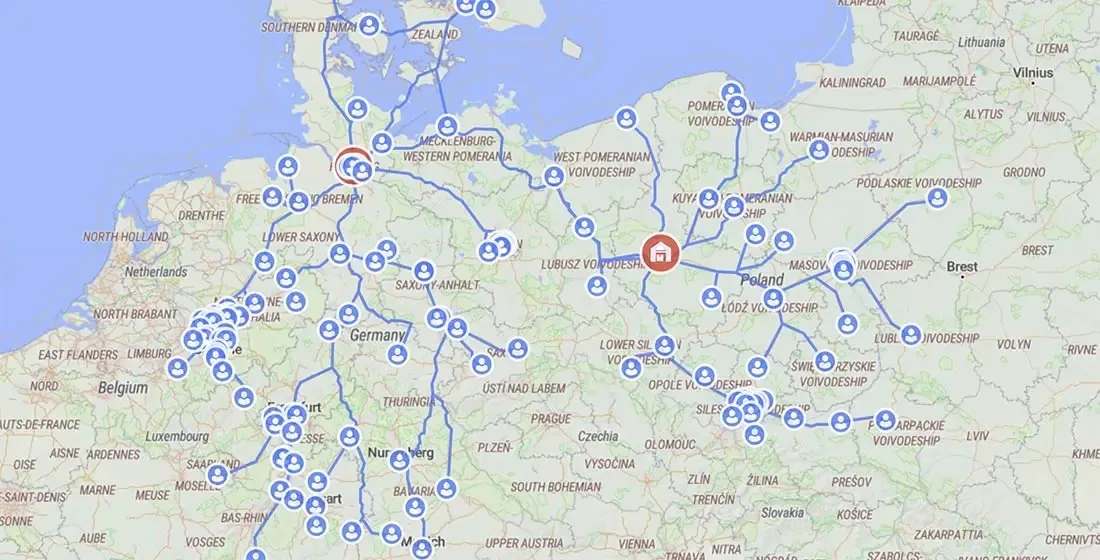
anyLogistix (from the makers of AnyLogic) is built specifically for supply chains. It combines optimization, which finds the best possible design on paper, with simulation, which shows how that design holds up in the real world with all its ups and downs. You work right on a map, placing factories, warehouses and customers, and then ask questions like: Where should we put our warehouses? How much inventory should each one hold? What happens if a supplier goes down? It’s a big step up from trying to plan a supply chain in a spreadsheet, and companies like Coca-Cola İçecek and Danone have used it to plan their supply chains. The picture at the top of this post shows an anyLogistix model of a distribution network, with lines connecting each distribution center to the customers it serves.
JMP Pro
JMP Pro is statistics software that turns data into decisions. Before you can build a good digital twin, you need to understand your data: How long do machines really run before they break? How much does demand change from week to week? JMP Pro makes it easy to explore data visually, build models that predict what will happen next, and design experiments that find out which changes actually make a difference. Its motto sums it up nicely: all the power, none of the complexity.
Why this matters for your career
When you apply for internships and jobs, “I learned about simulation” is nice. “I built a digital twin of a distribution network in anyLogistix and used it to cut costs by 12%” gets you noticed. Employers are looking for people who can do more than follow a plan. They want people who can test ideas, measure risk and back up their recommendations with evidence.
At UM-Flint, you get to practice those skills in class, on real software, long before your first day on the job. And it isn’t just one class. We offer specialized advanced courses in simulation modeling and advanced business analytics, and we also build these tools into our operations, supply chain, logistics and quality management courses. So you’ll use them again and again, on all kinds of problems, until they feel like second nature.
Curious? Check out the Level Up page to learn more about our supply chain degree programs.